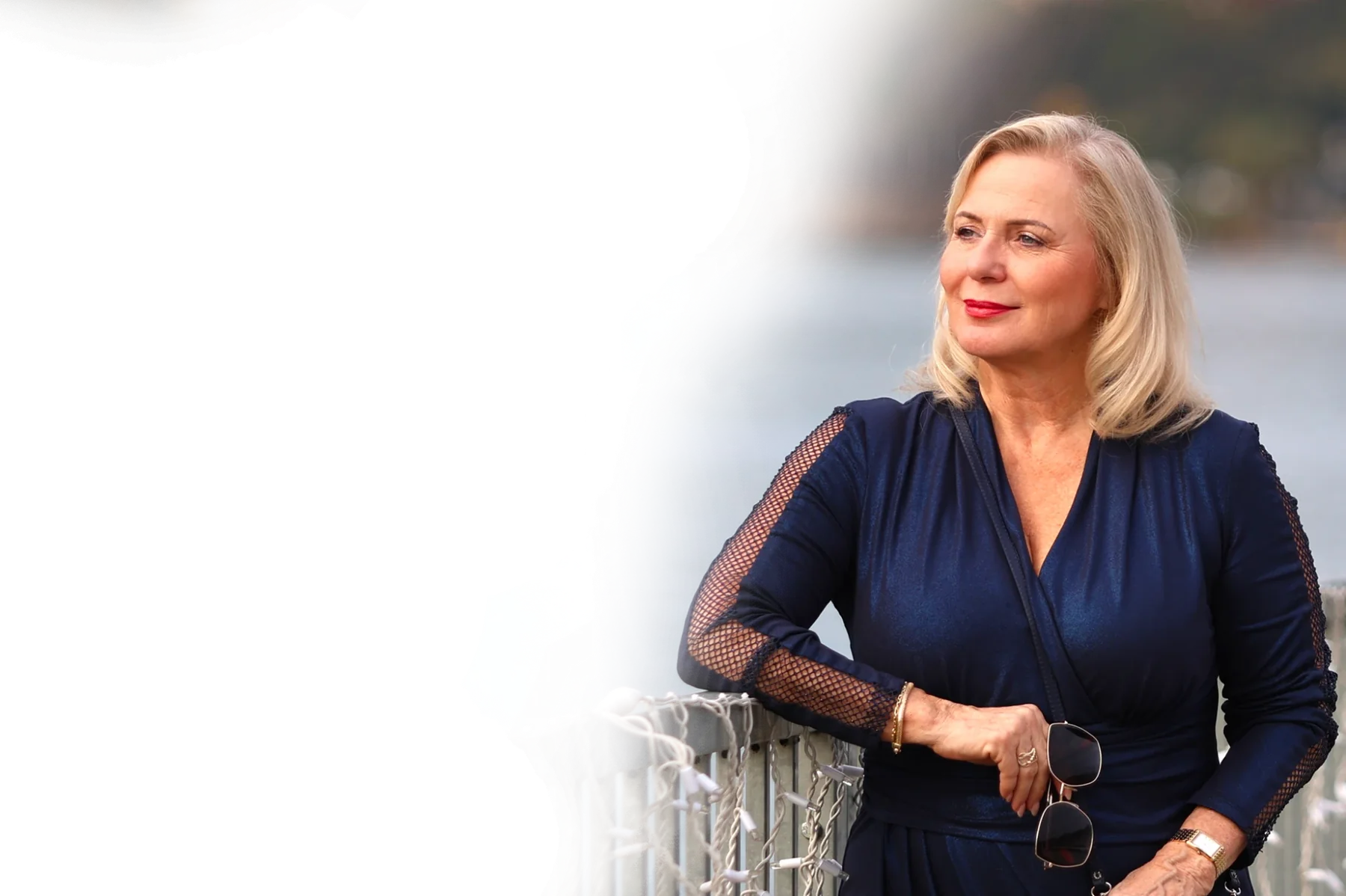

She Lit Up Prague Like Paris. I Love a Challenge, Says the Former Professor
Answers to questions from MF DNES and iDNES.cz, April 2023.
As I understand it, you began in 1998 by importing lighting from abroad.
It all began even earlier, when in the nineties my husband was running a cultural centre in Prague and together we organised concerts and exhibitions. With the changes in ownership structures, it was clear that the centre would be sold or leased. It was then that we met someone who was looking for a representative for a major French company producing Christmas lighting. We began working together and bought goods from them.
You joined the family business later. You were a teacher of Czech at a grammar school – what made you leave your profession? Was it a great dilemma?
It was difficult. I considered leaving for many years, because I got on very well with my students and truly loved my work, and friends tried to talk me out of it too. But I never expected how things would turn out. And when we fell in love with the idea of lighting up Prague like Paris – that is, of going our own way – the decision was made.
Weren’t you afraid that you would not succeed in the market and would regret leaving a secure position? And today – do you have regrets?
I don’t think I seriously admitted the fear of failing; I was more afraid that my colleagues would not accept me among them before I had proved any ability. Once I have made an inner decision, I do not question it. Perhaps only now, after all these years, has my choice confirmed what I had sensed. I love challenges, overcoming obstacles and fulfilling dreams. Yes, it was – and still is – the odd rush of adrenaline, but experience keeps that in check. Still, I certainly do not regret my decision.
What were your beginnings like, and how did you fare?
At that time only Christmas trees and motifs of public lighting were commonly decorated here; Christmas decoration, like other design disciplines, was only slowly coming to life. So it was a demanding period, but on the other hand, willingness to work and proven reliability were a huge asset in winning further commissions.
Do you remember your first commissions?
Among the first was the lighting of a bridge in Špindlerův Mlýn and Vrchlabí; in 1999 we also prepared decorations for a larger part of Prague, and that was a challenge – in the end we managed it with five people.
The first commissions came about quite literally on our knees, as the saying goes, but the very next year we had to move indoors, somewhere warm. First we renovated the boiler room in my parents’ house, then we rented larger premises, and finally, ten years ago, we bought a farmstead in Dobrovíz, which we repaired and transformed into the Christmas Courtyard. Today we are dealing with the expansion of our industrial sites and storage space in Nové Strašecí.
How do you win commissions? When it comes to, say, a city’s Christmas lighting, do you have to take part in a tender?
Yes, we mostly take part in tenders, unless the commission is a smaller one. Christmas decoration for shopping centres is awarded exclusively through competition, and only among the most significant suppliers. The Czech market is not that large, so the great majority of our customers return to us.
Your work is probably concentrated mainly in the pre-Christmas period. Does that mean you have to earn enough for the whole year during that time?
The seasonal nature of our work is indeed demanding on cash flow, and especially now, with rising input costs, we are looking for ways to spread it out more. We also install Easter and Valentine’s decorations, and fortunately more and more towns are realising that the magic of light matters not only at Christmas.
According to Forbes magazine, the Christmas tree in Prague that you decorated was named in 2020 among the TOP 21 most beautiful Christmas trees in the world. That is surely a success? How long does it take to prepare a commission such as the lighting of Old Town Square? How many people does it need, and from which professions?
The whole process runs from an idea through graphic design; then it has to be technically drawn out, everything produced, the installation and animation prepared, and finally installed. Perhaps around 20 people of all kinds of professions in total, over a matter of months.
How did you manage to reach the wider world? And is a foreign customer different from a Czech one?
In a way, opportunities opened up after an exhibition in Frankfurt am Main, though covid then closed them a little again. Decoration to the west of us is conceived far more universally, so in some parts of Europe we celebrate not just Christmas but the winter holidays.
We are learning to meet culturally quite different requirements as well, such as Ramadan or Halloween. In France, for example, depicting angels is not customary, the decoration is generally more avant-garde and bolder, the classic green Christmas tree does not succeed, and instead of our beloved green and red, orange and black dominate.
What are you most proud of? What was your greatest challenge among your commissions?
We are probably most proud of the exhibition Světla vyprávějí (Lights Tell Stories) at the Žluté lázně (Yellow Baths) in Prague.
It was a completely new and untested concept, a project with the largest number of light sculptures and decorations in one place to date, and we did not know how it would work. We invested enormous energy in production, organisation and installation, and in the end our expectations and intentions were confirmed: the exhibition became a considerable factor in Prague’s appeal to tourists, over 100,000 people visited it, and the response was wonderful.
The company is still a family one and has three managing directors – you, your husband and your son. Are your responsibilities divided, or do you vote on important decisions? Is it an advantage to do business within the family?
We have divided responsibilities, but they overlap, and today we know that our distinct characters are also a kind of driving force and that, at times, we spur one another on through stormy discussion. The advantage of a family business, if it rests on firm bonds, is a pleasant mutual support. On the other hand, the absence of any distance is demanding.
These times do not favour wasting energy, and towns are trying to save. Aren’t you afraid that they will start saving precisely on commissions of this kind? Or are you already noticing something like that?
We should always be considerate and economical, regardless of the times. None of our customers explicitly curtailed decoration last year; some small gestures were more declaratory in nature. Moreover, modern technology allows for fairly undemanding operation – for instance, lighting Old Town Square at Christmas for the whole season, that is 40 days, came to 4,200 crowns. And if one wants to take a thrifty approach, there is a whole range of options to choose from – switching off the Christmas lights is the very last of them.
Your company has been on the market for 25 years. What is important for success in business? And when you began, did you have any idea how far you would go?
I confess I did not imagine anything at all. I simply always try not to do things below standard. Success is relative, and for me what matters is that through our business we can bring joy. The angels on Old Town Square and the recognition of our decoration please me. I think that what is important in everything we do in life is to believe in our intention and turn it into life. Only then does a person remain convincing, authentic and credible. That matters in business just as in life – except that in business one takes on a little more responsibility for others as well.
Do you have permanent employees, or do you hire them for individual commissions?
We have almost 50 permanent employees and also work with further seasonal helpers, some of them for over 20 years, but every year we look for new colleagues to help out in various ways.
Is it hard to find someone skilled?
Our professions are rather specific, but on the other hand the more creative ones offer a degree of self-fulfilment. Today there is a shortage of quality workers across industries, including precisely the manually skilled workers we need.
Will you tell us your turnover?
Despite the energy crisis we grew by 20%, that is, from 100 to 120 million.
What does money mean to you?
We are in business, so money is a resource for meeting needs. It is not the decisive motivation; it provides a certain independence, but it is not the yardstick.
What are your plans for the future?
To kindle, to illuminate, and to keep my own inner light alive, because only so can I make anything shine.
Published: iDNES.cz, 29 April 2023.